The operational intelligence platform behind every Mitori deployment decision.
Mitori is the governed system that turns observed work into audits, decision-ready roadmaps, deployment packets, and operating feedback loops from Seed through to Mitori Control.
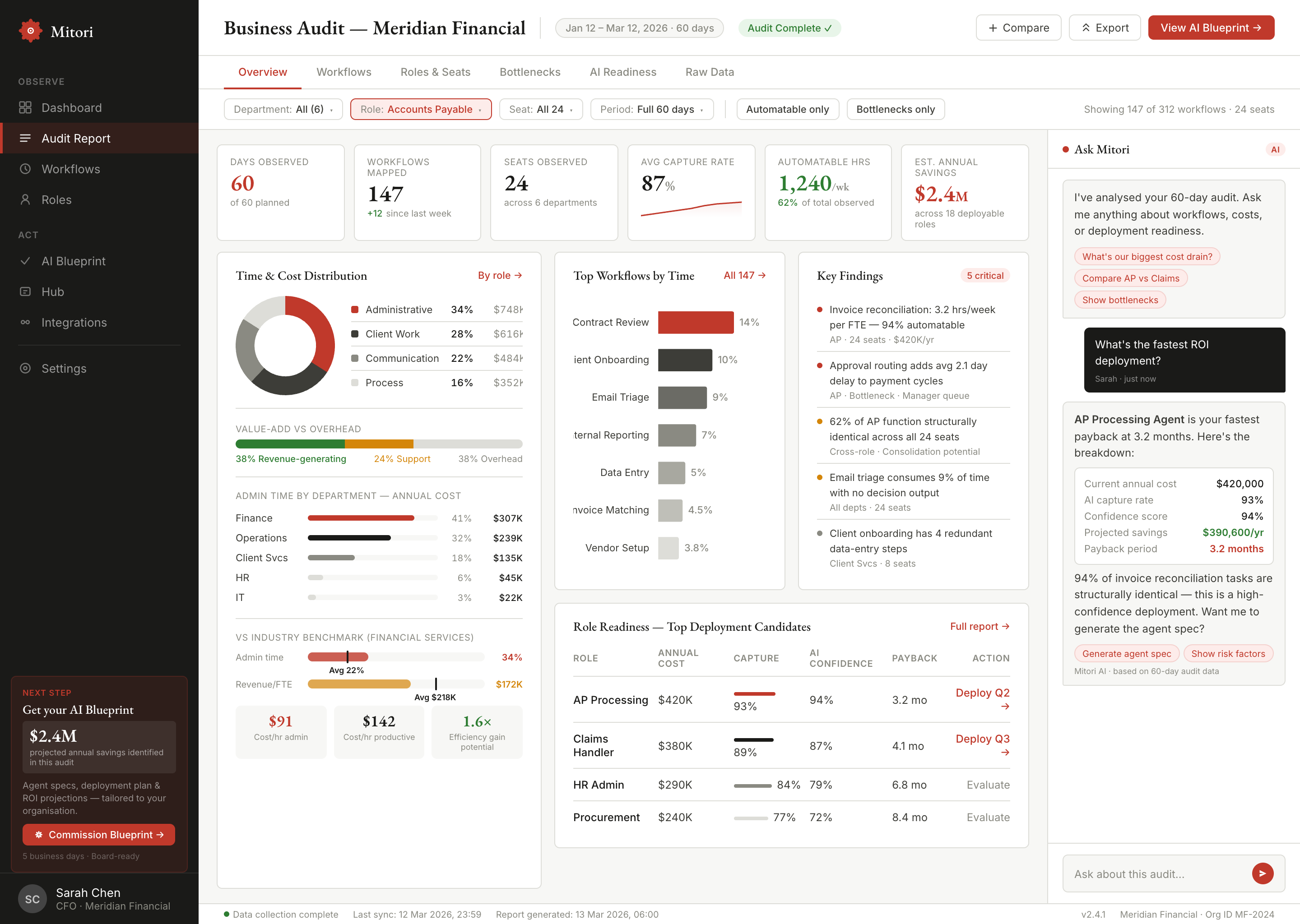
The product starts with governed inputs.
Consent, scope, and minimization rules are built into the data model before any workflow insight is generated.
Input 01
Access scope configuration and engagement parameters
Input 02
Full-spectrum observation: app usage, browser activity, keystrokes, screen recording, email, and handoffs
Input 03
Source documents such as SOPs, org charts, and integration specs
Input 04
Role context, policy constraints, and manager annotations
From raw events to approved deployment work.
01
Observation model
Raw application and workflow events are captured as governed signals rather than loose notes.
02
Workflow reconstruction
Those signals become workflows, role profiles, exception paths, and evidence packs that teams can inspect.
03
Decision scoring
Every candidate is scored for value, effort, payback, confidence, and governance risk before rollout begins.
04
Delivery handoff
Approved candidates are packaged into delivery programs, workstreams, and implementation packets.
The audit produces agent-ready data, not a slide deck.
Every Mitori audit generates structured JSONL implementation packs — machine-consumable records that any orchestration platform, delivery team, or Mitori Monitor instance can ingest directly.
"workflow_id": "wf_transport_consent",
"schema_version": "v3.0",
"step_id": "s07a",
"step_type": "parallel",
"parallel_group": "s07",
"parallel_siblings": ["s07a", "s07b"],
"step_index": 7"systems": [
{ "role": "primary",
"app_name": "SmartSuite",
"browser_domain": "app.smartsuite.com" },
{ "role": "input_source",
"app_name": "Gmail",
"browser_domain": "mail.google.com" },
{ "role": "output_target",
"app_name": "HelpScout",
"browser_domain": "secure.helpscout.net" }
]"actors": {
"primary": [{
"role": "transport_coordinator",
"department": "logistics",
"seniority": "L3"
}],
"secondary": [{
"role": "operations_manager",
"department": "operations",
"approval_authority": true
}],
"observed_user_count": 4,
"role_variants_detected": 2
}"action": {
"type": "create_ticket",
"trigger": "consent_verified",
"input_refs": [
"consent_email::hash_a7f3c",
"clinic_request::hash_d91e2",
"patient_transport_order::hash_b44e1"
],
"output_schema": "ticket_payload_v1",
"idempotency_key": "wf_tc::s07a::{{run_id}}",
"retry_policy": {
"max_attempts": 3, "backoff_ms": 2000
}
}"automation": {
"fit_score": 0.88,
"fit_confidence": 0.91,
"mode_recommendation": "adaptive",
"blockers": [],
"estimated_duration_ms": 4200,
"fallback_strategy": "human_queue",
"agent_compatibility": [
"n8n", "make", "temporal", "langchain"
]
}"sla": {
"target_completion_ms": 300000,
"escalation_after_ms": 600000,
"breach_action": "notify_ops_manager",
"business_hours_only": true,
"timezone": "Australia/Sydney"
}"governance": {
"approval_required": true,
"approval_type": "manager_sign_off",
"sensitivity": "phi_metadata_only",
"data_classes": [
"patient_id_hash", "clinic_ref",
"consent_token"
],
"retention_policy": "90d_then_purge",
"audit_trail": true,
"encryption_at_rest": "aes256"
}"compliance": {
"frameworks": [
"SOC2_CC6.1",
"HIPAA_164.312",
"ISO27001_A.12"
],
"last_reviewed": "2026-03-01",
"reviewer_role": "compliance_officer",
"next_review_due": "2026-06-01"
}"cost_model": {
"manual_cost_per_exec_aud": 14.20,
"automated_cost_per_exec_aud": 0.03,
"monthly_volume": 847,
"projected_monthly_saving_aud": 12001.99,
"annual_roi_multiple": 8.4
}"evidence": {
"observation_refs": [
"evt_1821", "evt_1822",
"evt_1847", "evt_1903"
],
"sample_count": 34,
"observation_window":
"2026-02-01/2026-03-02",
"variant_count": 3,
"exception_rate": 0.06,
"mean_manual_duration_ms": 187000,
"p95_manual_duration_ms": 312000
}"lineage": {
"seed_cycle": 2,
"parent_workflow_id":
"wf_transport_consent_v1",
"drift_detected": false,
"last_reseeded":
"2026-03-10T09:41:00Z",
"change_delta":
"+2 steps, -1 manual handoff"
}"execution_context": {
"environment": "production",
"region": "ap-southeast-2",
"tenant_id": "org_acme_health",
"deployment_target": "mitori_control"
},
"dependencies": {
"upstream": ["s06_consent_check"],
"downstream": [
"s08_notify_clinic",
"s09_schedule_pickup"
],
"parallel_join": "s07b_update_ehr",
"system_integrations": [
"smartsuite_api",
"helpscout_api", "gmail_api"
]
}One record per workflow step. Each encodes multi-system routing, actor hierarchies, parallel execution DAGs, SLA escalation rules, compliance framework references, per-step cost models, and re-seeding lineage. Orchestration platforms, delivery teams, and Mitori Control consume these directly — no manual translation required.
Automation platforms solve the wrong problem first.
Browser agents and RPA tools can execute a workflow once you know what to automate. But most enterprises fail before that point — they do not know which workflows to prioritize, what the real operational constraints are, or how to sequence rollout safely.
Mitori starts one step earlier: proving what should be automated, in what order, under what governance constraints, and with what implementation payload. The audit evidence then feeds directly into any execution layer — including partner-delivered builds.
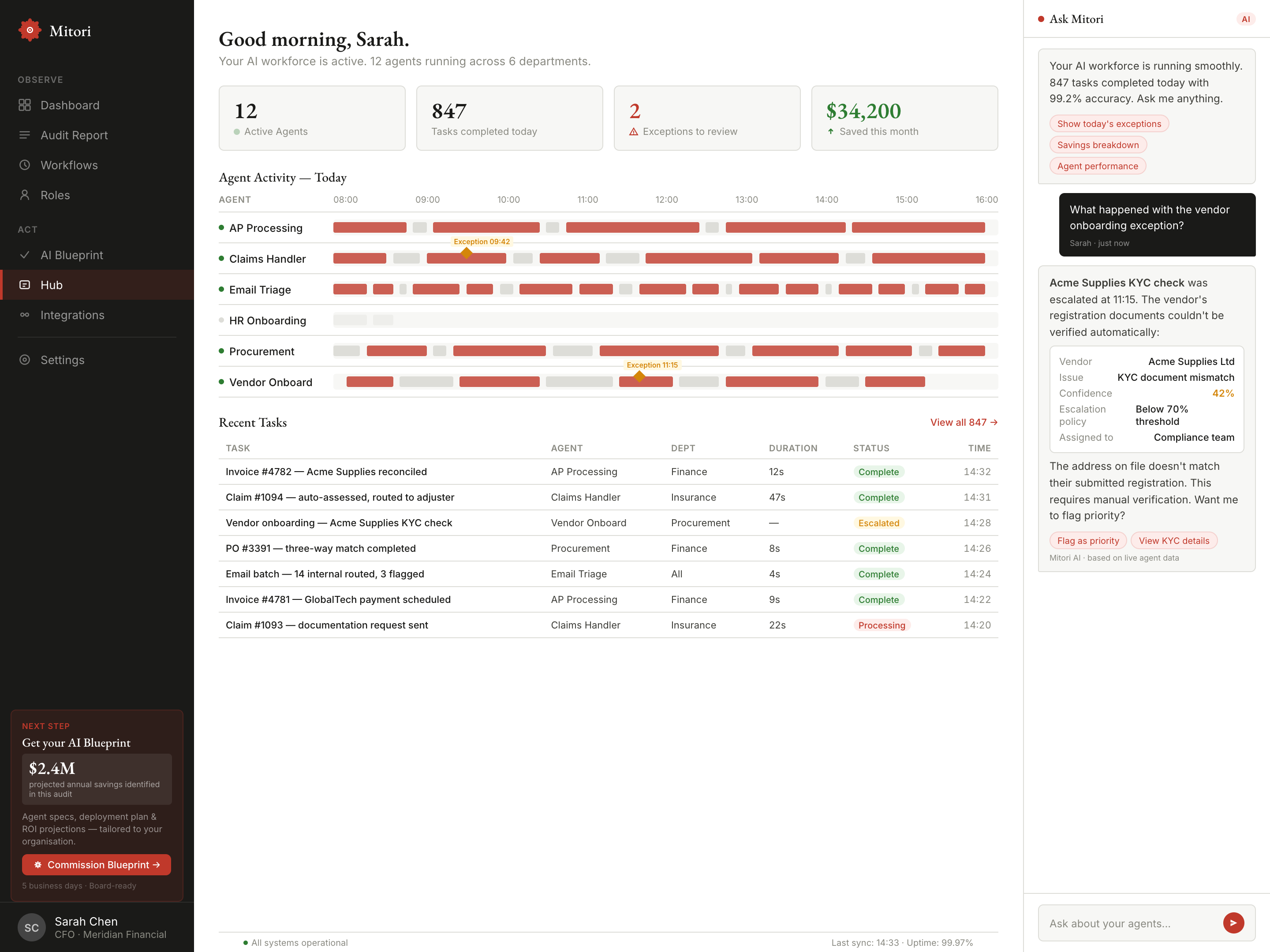
One platform, three operating surfaces.
Guided product pilot
For smaller teams that want the product experience first without losing the structured audit model.
Enterprise decision workspace
For larger buyers who need deeper governance, approved roadmap sequencing, and board-ready ROI framing.
Mitori Monitor
For ongoing monitoring of deployments, forecast-vs-realized value, exception handling, and re-seeding into the next optimization cycle.
Approved work becomes a deterministic handoff.
When a client approves the roadmap, Mitori packages the next wave into a delivery program that can move into implementation and Mitori Monitor without re-running discovery.
01
Delivery program
02
Workstream
03
Work package
04
Handoff packet